

Pliska
Bulgaria’s first capital preserves palaces, defences and the early Christian state centre.
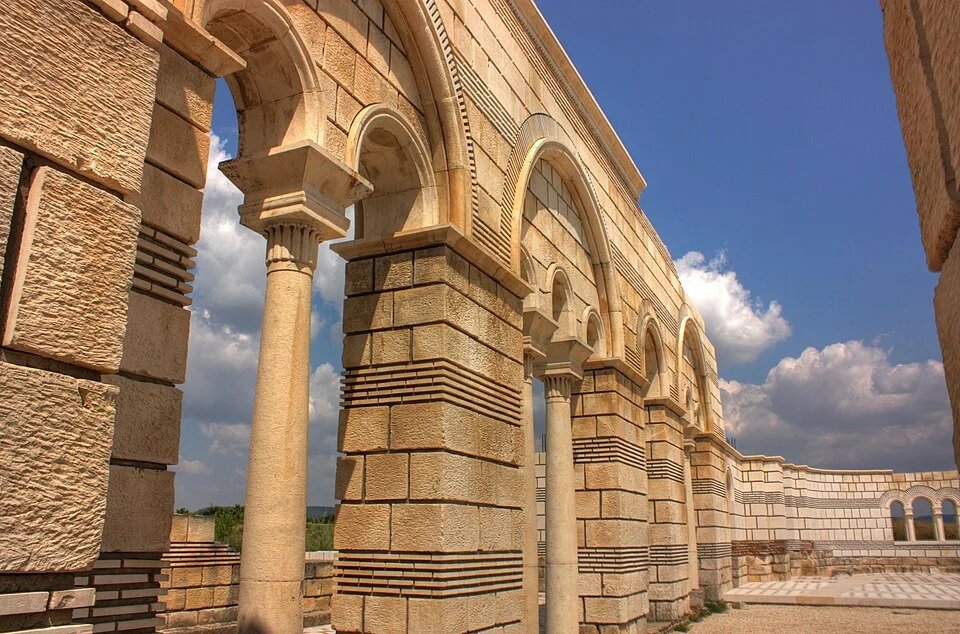 Open and enlarge photograph
Photo: Klearchos Kapoutsis from Paleo Faliro, Athens, Greece · CC BY 2.0 · Retained optimized WebP from the existing editorial collection; no additional modification.
The story of this place
Pliska preserves major changes in the early Bulgarian state. After the capital was burned in 811, its palace centre was rebuilt with monumental stone structures. Water pipes, baths and service buildings reveal how the royal residence functioned. Conversion to Christianity in the ninth century transformed religious architecture, and the Great Basilica with its surrounding complex became an important ecclesiastical centre. Excavations began in 1899, making today’s ruins the outcome of prolonged research and conservation. The museum presents seals, inscriptions and objects that add everyday detail to the monumental story. Surviving ancient masonry should be distinguished from modern reconstruction, while the names given to individual palaces belong within a broader archaeological interpretation of their phases.
What the evidence shows
- Archaeological investigations began in 1899.
- Palace buildings, water pipes and the Great Basilica have been exposed.
Hypotheses and open questions
Names such as Krum’s and Omurtag’s palaces interpret building phases rather than surviving labels on the buildings.
Myths and local traditions
The sources consulted do not document a reliable local tradition. We do not invent legends to fill the gap.
Sources and verification
These accounts are editorial summaries. The sources below let you check dates, discoveries and interpretations.
- РИМ–Шумен: Плиска ↗museum-shumen.eu
- Министерство на туризма: Плиска ↗www.tourism.government.bg