

Madara and the Madara Rider
The rock relief and surrounding reserve reveal a long-lived sacred and fortified place.
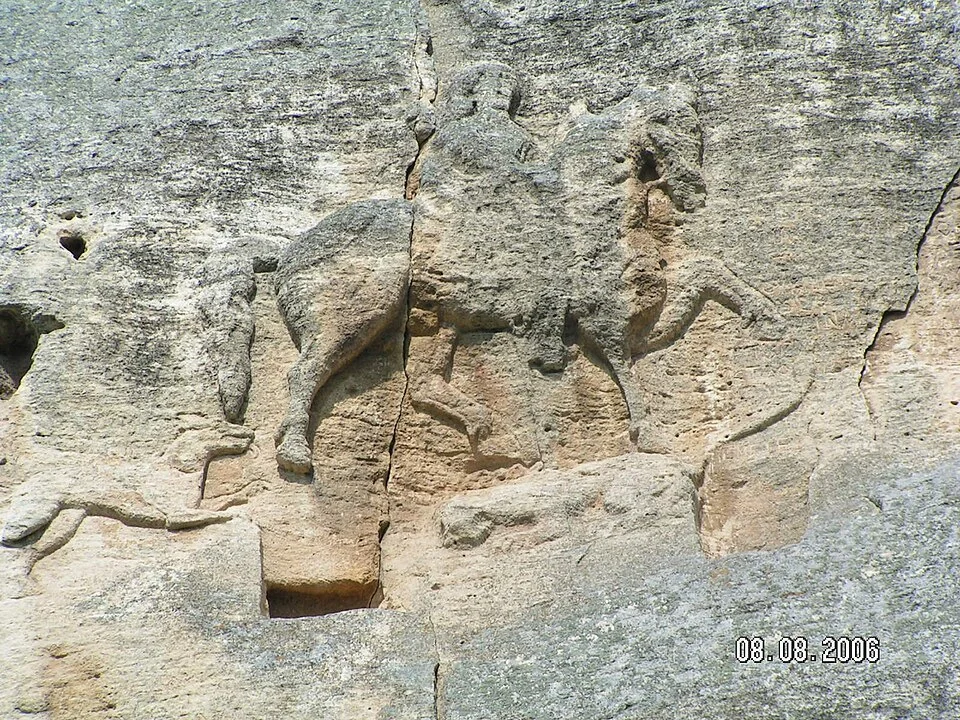 Open and enlarge photograph
Photo: No machine-readable author provided. Dom2002 assumed (based on copyright claims). · Public domain · Retained optimized WebP from the existing editorial collection; no additional modification.
The story of this place
The Madara Rider was carved into the high cliff near Madara in the early eighth century. A mounted figure, a lion and a dog form the composition, while Greek inscriptions around it provide historical evidence for the early Bulgarian state. UNESCO inscribed the monument in 1979. The surrounding reserve extends beyond the relief itself: ancient and medieval structures, sacred spaces and a fortress demonstrate the area’s long use. The carving survives in its authentic location, although erosion affects the rock surface. A visit allows the monumental image to be considered alongside nearby archaeology. Its association with early Bulgarian rulers should not be simplified into a securely identified portrait of one individual without acknowledging interpretation.
What the evidence shows
- The relief dates to the early eighth century.
- Its surrounding inscriptions are in Greek.
Hypotheses and open questions
The rider’s precise identity and symbolic meaning remain matters of interpretation.
Myths and local traditions
The sources consulted do not document a reliable local tradition. We do not invent legends to fill the gap.
Sources and verification
These accounts are editorial summaries. The sources below let you check dates, discoveries and interpretations.
- ЮНЕСКО: Madara Rider ↗whc.unesco.org
- Министерство на туризма: старите столици и Мадара ↗www.tourism.government.bg