

This researched article is available in English and български.
Ulpia Oescus
A Roman city with a forum, temples, streets and the theatrical “Achaeans” mosaic.
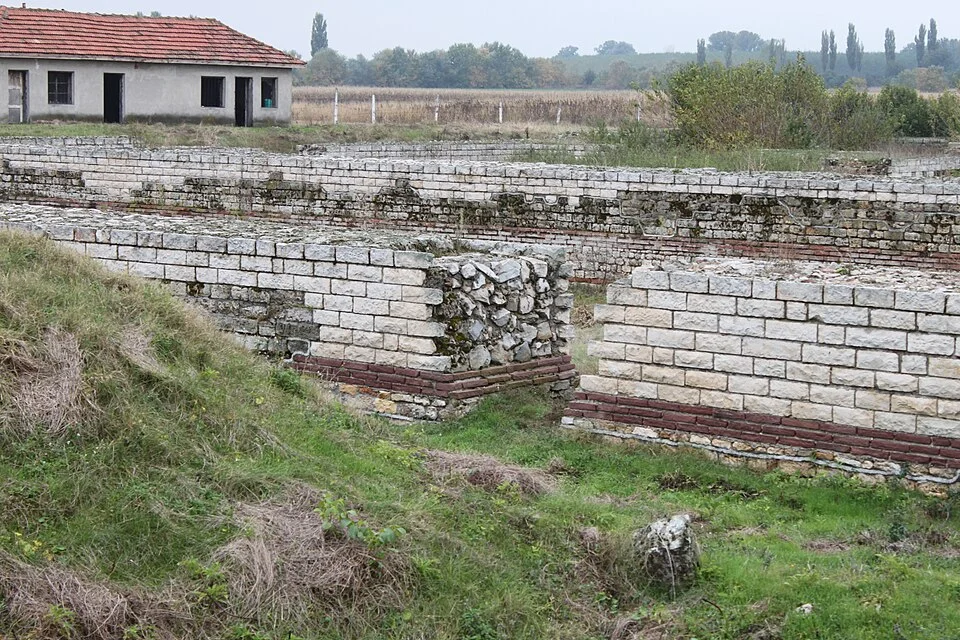 Open and enlarge photograph
Photo: Bin im Garten · CC BY-SA 3.0 · Retained optimized WebP from the existing editorial collection; no additional modification.
The story of this place
Ulpia Oescus near Gigen demonstrates the organisation of a major Roman city on the Lower Danube. Straight streets, a forum, temples, public buildings and drainage belonged to a planned urban environment. An inscription dates construction of the Temple of Fortuna to AD 190–192. Excavations also uncovered the multicoloured mosaic depicting a scene from the comedy “Achaeans”, subsequently conserved in Pleven. A renewed period of prosperity under Constantine included the opening of a Danube bridge in 328. The ruins and museum collections should be considered together, since some of the most significant original objects are no longer at their excavation locations.
What the evidence shows
- A building inscription dates the Temple of Fortuna to AD 190–192.
- The “Achaeans” mosaic is preserved at Pleven Museum.
Hypotheses and open questions
The visible ruins and original finds in Pleven and Sofia represent different parts of the city’s surviving evidence.
Myths and local traditions
The sources consulted do not document a reliable local tradition. We do not invent legends to fill the gap.
Sources and verification
These accounts are editorial summaries. The sources below let you check dates, discoveries and interpretations.
- Община Плевен: Улпия Ескус ↗pleven.bg
- РИМ–Плевен: Археология ↗rim-pleven.com