

Sexaginta Prista
A Roman fort above the Danube occupying an earlier ritual and settlement landscape.
 Open and enlarge photograph
Photo: Rossen Radev · Public domain · Resized proportionally to a maximum of 960 px and converted to WebP; no crop or scene edits.
The story of this place
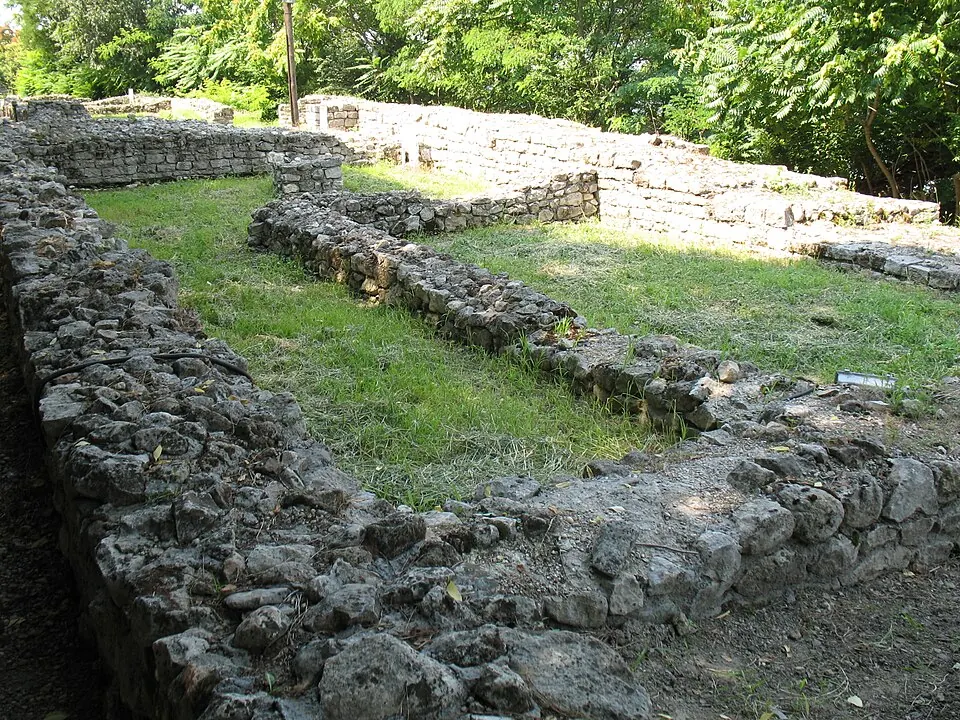
Sexaginta Prista lies within modern Ruse, where successive layers reveal changing uses of an important riverside location. A ritual pit complex and civilian buildings preceded the Late Roman fort. Excavators identified a temple of Apollo with an inscribed altar; the military headquarters, or principia, was later built above it. Surviving wall and tower sections belong to the Late Antique castellum. The site is presented as an open-air museum. These visible structures must be distinguished from the first Roman camp, whose location remains unestablished in the museum’s account.
What the evidence shows
- An inscribed altar identifies the temple of Apollo.
- Excavations exposed a wall, tower and principia.
Hypotheses and open questions
The first–third-century camp has not been securely located; the precise meaning of earlier rituals is also unknown.
Myths and local traditions
The sources consulted do not document a reliable local tradition. We do not invent legends to fill the gap.
Sources and verification
These accounts are editorial summaries. The sources below let you check dates, discoveries and interpretations.
- РИМ–Русе: Сексагинта Приста ↗www.museumruse.com
- Общински туристически портал Русе: Сексагинта Приста ↗visitruse.bg