

Marcianopolis and the Museum of Mosaics
Ancient Marcianopolis is revealed through an urban house with richly decorated mosaic floors.
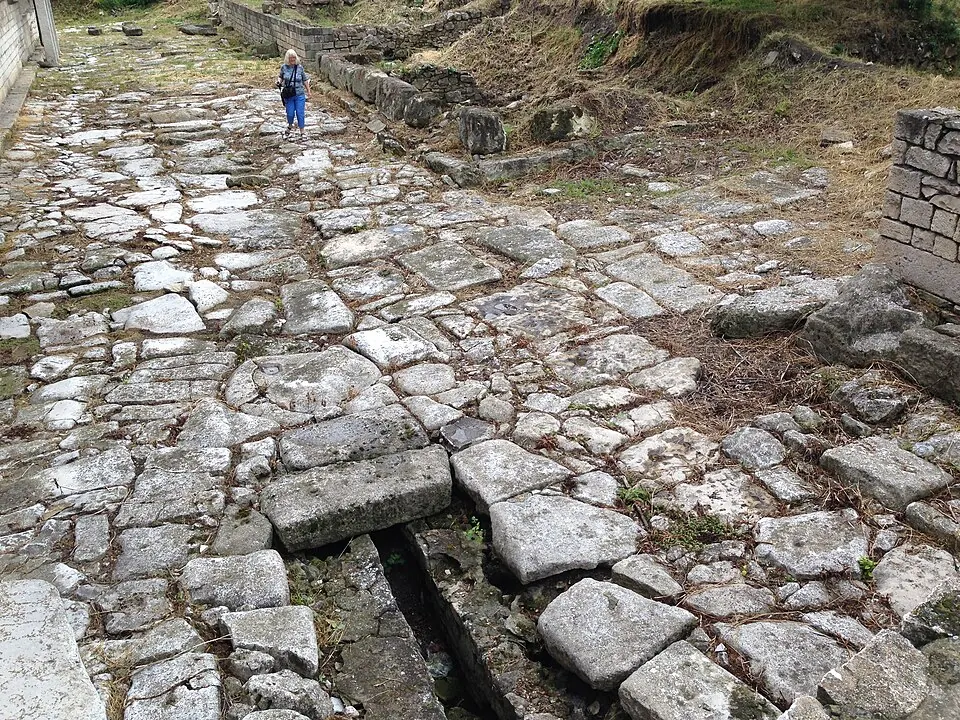 Open and enlarge photograph
Photo: Rjdeadly · CC BY-SA 4.0 · Resized proportionally to a maximum of 960 px and converted to WebP; no crop or scene edits.
The story of this place
The Museum of Mosaics in Devnya preserves part of a substantial urban house in Marcianopolis. Excavations began in 1976. The mosaic building dates to the late third and early fourth centuries AD and occupied an entire city block. Domestic and service rooms surrounded an internal courtyard, while the decorated floors combined geometric designs with figures from Graeco-Roman mythology. Medusa and a scene involving a satyr and Antiope are among the best-known subjects. Some mosaics remain where they were discovered; others were conserved on new supports. Household and architectural objects provide additional context. The museum presents one wealthy residence, whose decoration should not be assumed to represent the homes of every ancient inhabitant.
What the evidence shows
- Three mosaics are displayed in their original positions.
- The house had an internal courtyard and numerous rooms.
Hypotheses and open questions
The consulted evidence does not establish the owner’s name or biography.
Myths and local traditions
Medusa is a mythological figure. Her image is interpreted as protection against evil, describing an ancient belief rather than a real property of the mosaic.
Sources and verification
These accounts are editorial summaries. The sources below let you check dates, discoveries and interpretations.
- Община Девня: Музей на мозайките ↗www.devnya.bg
- Община Девня: Мозайките ↗devnya.bg
- Община Девня: музейната сграда ↗devnya.bg