

Kozarnika Cave
A cave with a long Palaeolithic sequence, human remains and tools informing research into the early peopling of Europe.
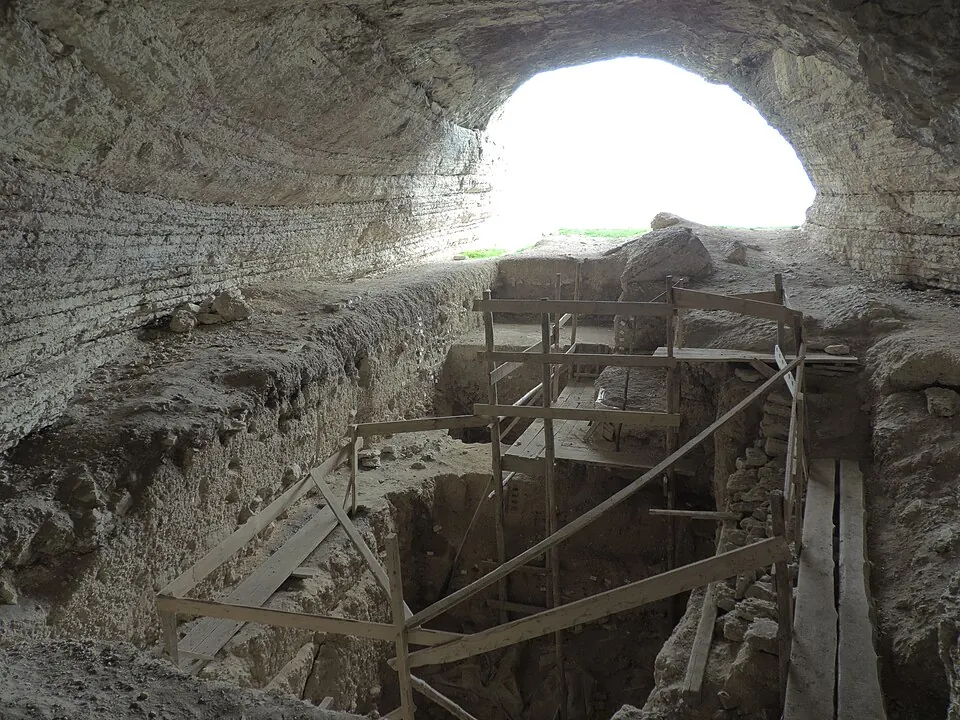 Open and enlarge photograph
Photo: Vassia Atanassova - Spiritia · CC BY-SA 4.0 · Resized proportionally to a maximum of 960 px and converted to WebP; no crop or scene edits.
The story of this place
Kozarnika preserves Lower, Middle and Upper Palaeolithic deposits. Bulgarian–French investigations recovered stone tools, animal bones and human remains. A 2017 study linked an infant radius from a Middle Palaeolithic layer to the hypothesis of early Neanderthal presence in the Balkans. New radiocarbon measurements published in 2026 refine later occupations, assigning phase 6/7 a range of approximately 48,500–44,050 calibrated years before AD 1950. This dates a particular phase, not the deepest deposits. The local museum also highlights flint cores and bones bearing incisions.
What the evidence shows
- A 2026 study uses 37 new radiocarbon measurements.
- The infant radius studied in 2017 comes from layer 10b.
Hypotheses and open questions
Alternating Neanderthal and Homo sapiens use during phase 6/7 is a proposed scenario, not demonstrated cohabitation. Interpreting bone incisions as counting or symbolic behaviour also requires caution.
Myths and local traditions
The sources consulted do not document a reliable local tradition. We do not invent legends to fill the gap.
Sources and verification
These accounts are editorial summaries. The sources below let you check dates, discoveries and interpretations.
- Hopkins et al., PaleoAnthropology (2026): A Refined Chronology for Kozarnika Cave ↗paleoanthropology.org
- Tillier et al., Journal of Human Evolution (2017): The infant radius from Kozarnika Cave ↗pubmed.ncbi.nlm.nih.gov
- ИМ–Белоградчик: Пещера Козарника ↗museum-belogradchik.com