

Abritus
An ancient city with defensive walls, substantial buildings and inscriptions establishing its identity.
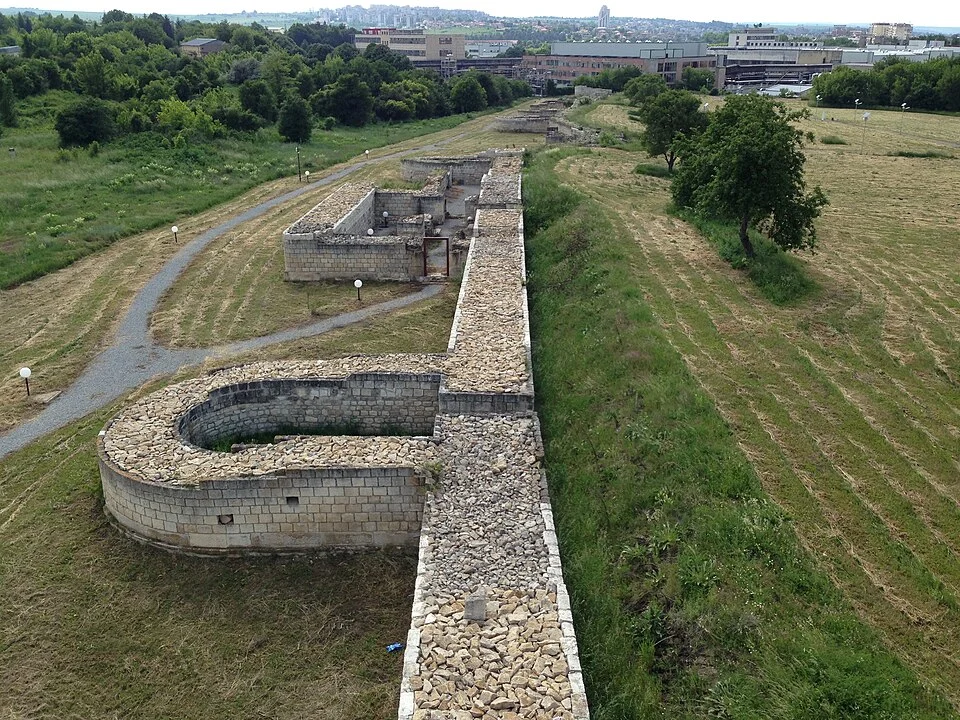 Open and enlarge photograph
Photo: Rjdeadly · CC BY-SA 4.0 · Retained optimized WebP from the existing editorial collection; no additional modification.
The story of this place
Abritus near Razgrad emerged during the Roman period and developed as an urban centre on important roads. The visible defences relate mainly to the Late Antique city, protected by walls, gates and towers. Latin inscriptions establish its name rather than a historical guess alone. Excavation revealed residential, public and Christian buildings as well as later reuse. A hoard of 835 fifth-century gold solidi was discovered in 1971. Museum routes connect standing remains with stone monuments and exhibitions, revealing the people, religious imagery and everyday objects behind the monumental architecture of the ancient settlement.
What the evidence shows
- Latin inscriptions establish the name Abritus.
- A hoard of 835 gold solidi was found in 1971.
Hypotheses and open questions
The battle of 251 is described as occurring near Abritus; it should not automatically be placed inside the later visible fortification.
Myths and local traditions
The sources consulted do not document a reliable local tradition. We do not invent legends to fill the gap.
Sources and verification
These accounts are editorial summaries. The sources below let you check dates, discoveries and interpretations.
- РИМ–Разград: Археологически резерват Абритус ↗abritus.bg
- РИМ–Разград: Маршрути в Абритус ↗abritus.bg
- РИМ–Разград: Отдели ↗abritus.bg