

This researched article is available in English and български.
Diocletianopolis
Walls, baths and early Christian buildings outline the ancient town around Hisarya’s mineral springs.
 Open and enlarge photograph
Photo: Valpamoukov · CC BY-SA 4.0 · Retained optimized WebP from the existing editorial collection; no additional modification.
The story of this place
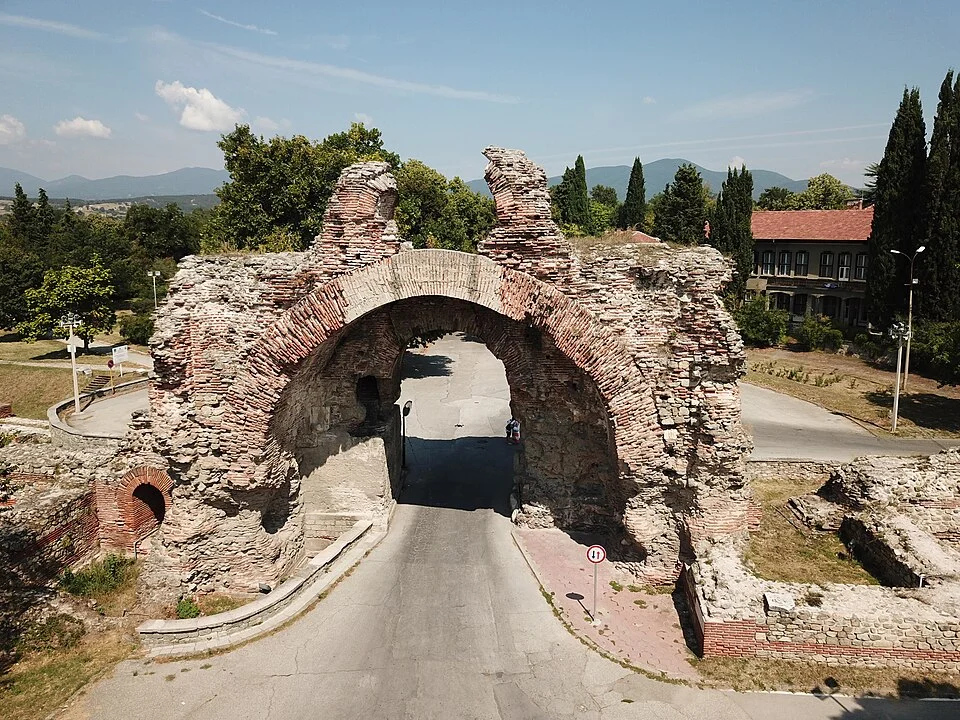
Diocletianopolis developed an urban setting around mineral springs used in the Roman period. Defences, baths, houses and churches show the relationship between water, protection and public life. The city received its name in the age of Diocletian and continued to develop during Late Antiquity. Its southern gate, now called the Camels, is particularly recognisable. The appearance seen today reflects survival, damage and conservation. Archaeological work has also clarified structural arrangements that earlier reconstructions interpreted differently. A visit connects several individual monuments rather than a single fortress wall, offering a broader view of how an ancient spa town organised movement, water and its inhabited space.
What the evidence shows
- The circuit had four main gates.
- Baths, basilicas and water-supply installations survive.
Hypotheses and open questions
Details of the southern gate have been revised through research; popular reconstructions are not definitive evidence.
Myths and local traditions
The sources consulted do not document a reliable local tradition. We do not invent legends to fill the gap.
Sources and verification
These accounts are editorial summaries. The sources below let you check dates, discoveries and interpretations.
- Община Хисаря: Античният град Диоклецианопол ↗gotohisarya.com
- Община Хисаря: крепостна стена и съоръжения ↗gotohisarya.com